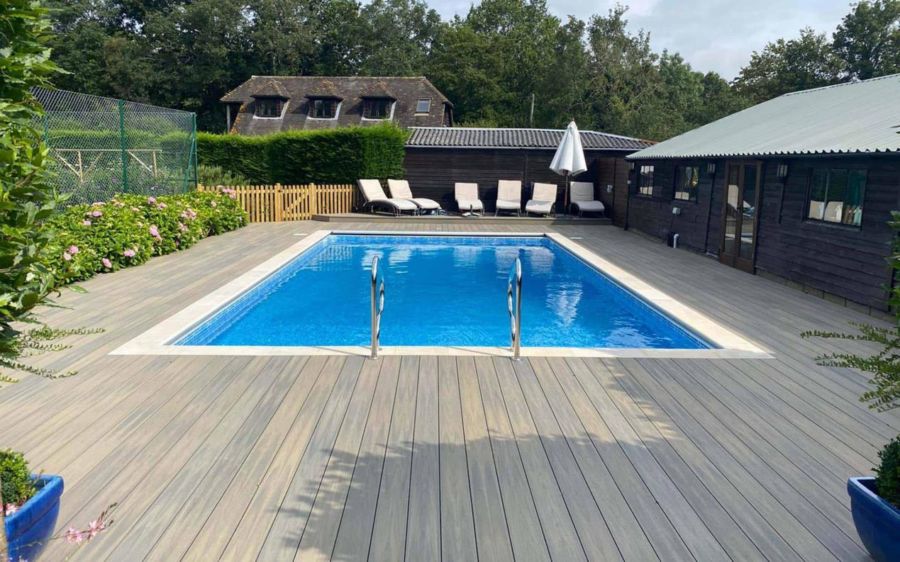
The hot summer months are quickly approaching, and you may be considering installing an above-ground pool in your backyard while you’re enjoying the outdoors. Having a above ground pool means more room for entertaining. When summer arrives, you can lounge on your pool deck and relax, or you can go swimming. What a delectable treat! But there is one thing to consider: what material is best for above-ground pool decks?
Once upon a time, pressure-treated wood decking was one of the most popular building materials. It was commonly used as a pool deck as well as for outdoor decks and exterior cladding. When used as a pool deck, it must, of course, be waterproof and corrosion-resistant. Wood decking requires regular maintenance after installation, such as painting and other maintenance work.
As a result, an increasing number of people prefer composite decking because it is strong, durable, and low-maintenance. So, what’s the difference between these two kinds of decking?
Typical Wood Decking

Different types of wood floors have different characteristics. The most common types of wood floors are briefly discussed below.
1. Decking made of pressure-treated pine
Pressure-treated pine decking is a popular type of wood decking. It has the advantage of being the least expensive and most easily obtained. This type of wood decking can be found at any local building supply store.
However, because pine is a softwood, it is prone to rot, mold, and insect infestation, necessitating regular maintenance such as painting and sealing to ensure its longevity. Furthermore, pressure-treated pine decks undergo repeated cycles of thermal expansion and contraction in areas with large seasonal temperature changes. The outdoor deck may warp or crack as a result of this.
People usually walk barefoot on the pool deck. A splintered or cracked pine deck is unfit for human use. As a result, pressure-treated pine decking cannot be used on a pool deck.
2. Cedar wood decking
This deck is also made of softwood, but unlike pine, cedar has some natural resistance to mold and decay. When it gets hot, cedar decking begins to mold and rot.
Aside from being more rot resistant than pine decking. Cedar decking has the same drawbacks when used as a pool deck. For example, the deck surface is prone to cracking or crumbling and must be regularly sealed with a waterproof sealer. Regular maintenance is required to extend its life. Overall, cedar decking is not appropriate for pool decking.
3. The Hardwood Decking
Trees like IPE are commonly used as raw materials for hardwood decking. These hardwoods typically resist decay, mold, splintering, and slippage. They also have a long lifespan, lasting 25-30 years with little maintenance. Pressure-treated pine or cedar decks, as opposed to hardwood decks, can last for 15-20 years with proper maintenance.
Hardwood decks must also be regularly maintained. They are relatively simple to maintain, aside from regular cleaning of dirt and debris from the surface. You should also oil the hardwood on a regular basis to prevent it from fading due to UV light. Oiling a hardwood deck not only maintains its appearance, but it also improves the texture of the deck’s surface.
There are, of course, some disadvantages to using hardwood decking for a pool deck. For example, hardwood is heavy and difficult to transport and install. Hardwood decks, in particular, are three times more expensive to install than pressure-treated pine decks.
Composition of Stone

1. Poured concrete
Poured concrete is another popular pool deck material because it is long-lasting and water-resistant. To improve slip resistance, have the concrete surface brushed. Swimmers will be unable to walk barefoot and slip if the concrete contains water when the brushed surface is completed.
Concrete pool decking has the advantage of being able to be poured into any shape you want, whether it’s a curve or a geometric pattern, and it’s also quick to install. In addition, the cost of pouring concrete is low. The disadvantage is that it must be installed by a professional because concrete can begin to set in minutes. If you don’t handle it correctly, you might end up breaking it and starting over. The second disadvantage of concrete is that it can appear monotonous and unappealing.
2. Pavers Made of Cement Precast
Precast cement pavers, like poured concrete, are an excellent alternative. This material comes in a variety of shapes, including squares, rectangles, and octagons. Because of the variety of geometric shapes available, surface pattern design can be more creative. Precast cement pavers can be ordered in gray or earth tones in addition to the single color of poured concrete.
While this material is more convenient than poured concrete, it does have some drawbacks. If the cement pavers are not properly installed on a bed of excavated sand or gravel, they may sink. This causes an uneven pool deck surface, making it impossible for people to use their outdoor pools properly.
Materials for Composites
1. Composite Decking Materials
One of the primary advantages of composite decking is that it requires little maintenance. One of the main reasons why composite deck boards are the most popular pool decking material is because of this. Furthermore, composite materials are impervious to moisture, rot, and warping, which is critical. This is because pool decking is frequently exposed to water.
Furthermore, composite wood decking is resistant to stains and fading. It does not fade easily, even after prolonged exposure to UV rays, ensuring the appearance of the pool deck. While composite decking boards cost more than pressure-treated pine decking, they cost less than hardwood decking. However, they are less expensive than hardwood decking.
You not only save money on post-maintenance costs because composite deck boards require little to no maintenance. It also allows you to spend more time outside. The strength and durability of the composite material allow it to last for at least 25-30 years. If you use your pool deck correctly, you can even enjoy it for longer.
2. Decking made of PVC
Another popular pool decking material is PVC decking. It, like composite, is resistant to rot, mold, and moisture. However, PVC decking and composite decking are different. When there is water on the deck’s surface, PVC decking can become slippery, posing a hazard to those walking on it.
While PVC does not require routine maintenance, it can chip or crack in cold temperatures. If you live in an area with cooler temperatures during the season, it is not a good idea to use PVC decking as a pool deck.
To summarize
Because it combines cost, performance, appearance, and longevity, composite decking is better suited for pool decks. Of course, you must still choose the proper decking material based on your specific needs.
Summer is quickly approaching, so start planning your outdoor pool deck project now so you can enjoy the great outdoors.
Also read: Install Garden Canopies and Pool Shades for Relaxing Summer Evenings